

What is Volatility in Crypto Casino Games? Complete 2026 Guide
Why two games with 99% RTP can feel completely different to play.

The Quick Answer: Volatility measures how risky a game is, not how fair it is. High volatility games pay big but rarely (Crash at 100x), while low volatility games pay small but often (Dice at 2x). Both can have 99% RTP, but volatility determines how fast you can lose your bankroll.
Most players obsess over RTP and completely ignore volatility. This is a mistake. You can play a game with 99% RTP and still go broke in 10 minutes if the volatility is extreme.
Volatility controls the frequency and size of your wins, which directly impacts how long your bankroll survives.
In crypto casinos, volatility is transparent because games like Plinko and Crash let you adjust risk settings before each bet. Traditional slots hide volatility ratings entirely. This transparency is why our casino rating methodology prioritizes platforms with customizable volatility controls.
Volatility vs RTP: They’re Not the Same Thing
Players constantly confuse these two numbers. RTP tells you how much money returns to players over millions of bets. Volatility tells you how that money gets distributed: small wins constantly, or massive wins rarely.
Real Example: Same RTP, Completely Different Experience
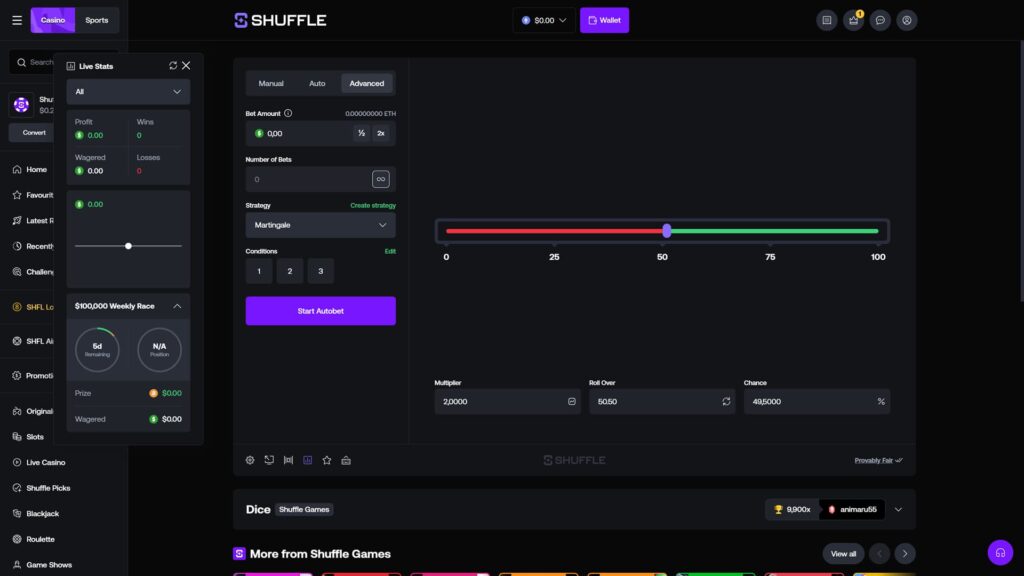
Take two games, both with 99% RTP. Dice on a 2x multiplier and Crash targeting 100x. Both are equally fair, but the experience is nothing alike:
Dice on 2x (Low Volatility): You win 49.5% of bets. Your balance moves slowly up and down. You can play for hours on $100.
Crash targeting 100x (High Volatility): You win 1% of bets. You lose 99 rounds, then hit one massive win. Your $100 can evaporate in 5 minutes or turn into $10,000.
Same fairness. Same long term expected value. Completely different bankroll survival rate.
You can lose your entire bankroll in 10 minutes on a 99% RTP game if volatility is extreme. How return percentages work alongside volatility to shape your actual session results is in our RTP guide.
Low, Medium, and High Volatility Explained
Every crypto casino game falls into one of three volatility categories. Understanding which type matches your bankroll and goals is critical for survival.
Low Volatility (Steady Grind)
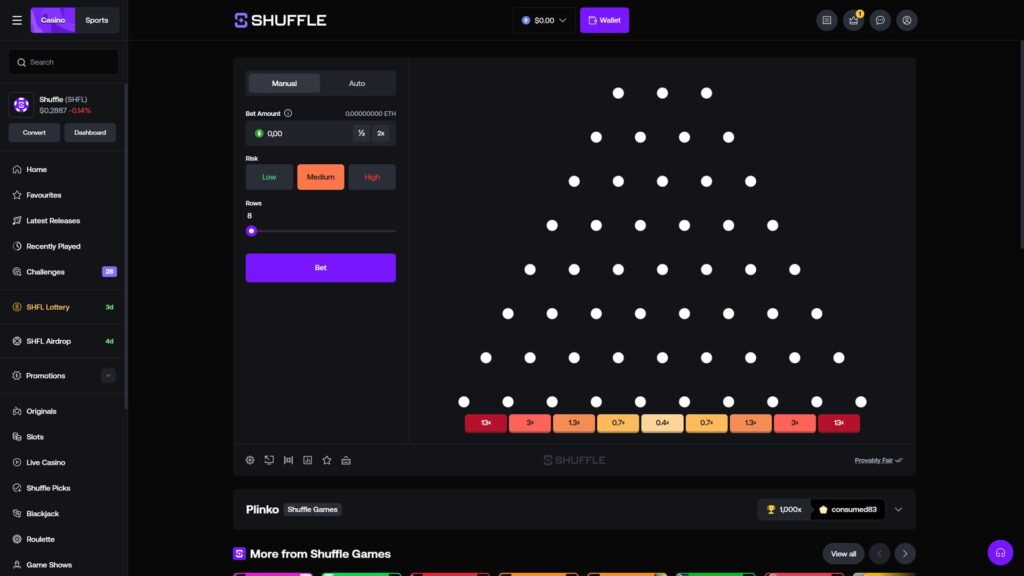
A good example is Plinko on Low Risk (8 rows). Win rates of 40% to 60% per drop and your balance moves slowly. This is the ideal setting for clearing wagering requirements without huge swings.
Medium Volatility (Balanced Action)
High Volatility (Extreme Swings)
A typical high volatility experience is Crash when targeting 100x or higher. You might bust 20 times before hitting that moon shot. Your $100 bankroll can be gone in minutes.
Matching Volatility to Your Bankroll Size
The biggest mistake players make is choosing volatility based on excitement instead of bankroll size. High volatility games are thrilling, but they will drain a small bankroll in minutes.
Match your volatility to your budget, not your emotions.
| Bankroll Size | Recommended Volatility | Strategy |
|---|---|---|
| $50 to $200 | Low Only | Dice on 2x, Plinko Low Risk |
| $200 to $1,000 | Medium | Plinko Medium Risk, Crash 5x to 10x |
| $1,000+ | All Levels | Limbo, Crash 100x, Mines max bombs |
If you have a large bankroll and enjoy extreme variance, games like Limbo are worth exploring. Even at 2x target, Limbo runs hotter than most originals.
Real Example: BC.Game Plinko Volatility Settings
At BC.Game, Plinko lets you choose your risk level before each drop. All three settings have the same 99% RTP, but the experience changes completely:
Low Risk (8 rows): Win 40% to 60% of drops. Max payout 5.6x. Your $100 bankroll lasts for hours.
Medium Risk (12 rows): Win 20% to 30% of drops. Max payout 33x. Moderate swings.
High Risk (16 rows): Win 5% to 10% of drops. Max payout 1,000x. Your bankroll can disappear in 50 drops or explode on one hit.
One Plinko game, three risk levels, three entirely different sessions. The RTP never moves.
High Volatility + Small Bankroll = Guaranteed Bust. Even with 99% RTP, high volatility games can drain your entire bankroll before a single big win hits. If you have $100 and target 100x on Crash, you need to survive roughly 99 losses before one win, and your bankroll cannot absorb that.
The house edge determines your expected loss rate, and volatility determines how that loss is distributed across your session. Both numbers together tell you how long your bankroll will last.
Crypto Casino Games Ranked by Volatility
Not all crypto casino games have fixed volatility. Most Provably Fair originals let you adjust risk settings on every bet. This table shows the volatility range for each game type and how to control it.
| Game | Min. Volatility | Max. Volatility | How to Adjust |
|---|---|---|---|
| Dice | Low | Extreme | Target multiplier (2x = low, 100x+ = extreme) |
| Plinko | Low | High | Risk level + row count (8 to 16 rows) |
| Mines | Medium | Extreme | Mine count (1 to 24 mines) |
| Crash | Medium | Extreme | Cashout target (2x = medium, 100x+ = extreme) |
| Limbo | High | Extreme | Target multiplier (always high, 1,000x+ = extreme) |
| Blackjack | Low | Low | Fixed. Cannot be adjusted. |
| Roulette | Low | High | Bet type (Red/Black = low, single number = high) |
| Traditional Slots | Medium | High | Fixed by provider. Cannot be adjusted. |
Crypto originals let you adjust volatility on every bet. Traditional slots and table games have fixed volatility set by the provider.
High volatility does not mean low RTP. Games like Dice and Limbo maintain 99% RTP even at extreme volatility settings because the return stays constant while only your bankroll swings get larger. Which platforms offer the best combination is in our highest RTP games list.
Every crypto casino implements these games differently. Volatility ranges and RTP for each original game are in our game by game comparison.
Frequently Asked Questions
No. Volatility and RTP are completely independent. A game can have 99% RTP with extreme volatility (Limbo) or 99% RTP with low volatility (Dice at 2x), because RTP measures long term fairness while volatility measures short term bankroll swings.
In provably fair games like Dice, Crash, and Plinko, volatility is locked based on your settings before the bet and the casino cannot change it. In traditional slots, volatility can spike during bonus rounds or free spins, which is why slots feel more unpredictable than crypto originals.
Use stablecoins like USDT or USDC for high volatility games. Playing with Bitcoin or Ethereum compounds two types of volatility: the game’s payout swings and the coin’s price swings. You could win 10x on Crash but lose 15% on Bitcoin’s price in the same hour, so stablecoins eliminate currency risk entirely.
Match Volatility to Your Goals
Low volatility for bonus clearing, medium for casual sessions, high for multiplier hunting. The right setting depends on your bankroll size and how long you want to play.
How volatility affects the real value of casino promotions is in our bonus value calculator, and our reviewed casinos list which risk settings are available on each game.
Tomas Lindgren is the Education and Responsible Gambling Editor at KryptoCasinos. With a journalism degree from Stockholm University and a postgraduate certificate in Digital Media from the University of Malta, Tomas spent three years covering cryptocurrency adoption across the Nordics before relocating to Malta in 2018. He specializes in breaking down complex crypto gambling concepts into step by step guides that anyone can follow. Based in Malta.