

Provably Fair vs RNG: Key Differences Explained
One system lets you verify every bet yourself. The other asks you to trust an auditor's report.

The Quick Answer: Provably Fair and RNG both generate random casino outcomes. The difference is who verifies the results. Traditional RNG relies on third party auditors who test systems quarterly. Provably Fair uses cryptographic proof that lets you check every bet yourself.
Crypto casinos run two fairness systems side by side. Slots and live dealer tables use Random Number Generators certified by labs like eCOGRA and iTech Labs.
Original house games use Provably Fair technology where you verify each result through cryptographic hashes. Both produce genuinely random outcomes. The gap is in how you confirm that.
How Traditional RNG Works
Traditional RNG systems run mathematical algorithms on casino servers that produce unpredictable number sequences. These sequences determine slot spins, card deals, and roulette outcomes.
You never see the code. You never access the seed values. You receive a result on screen and trust it came from a fair process.
How RNG Gets Verified
The casino contracts an independent lab like eCOGRA, which runs billions of simulations on the RNG software. If it passes statistical tests, the lab issues a certification badge the casino displays on their site.
You trust the auditor tested correctly and the casino did not modify the code after certification. The system runs on layered trust, not mathematical proof.
Where RNG Fits Best
Complex games with hundreds of variables need traditional RNG. Slots with weighted reels and bonus triggers, blackjack with penetration depth, and roulette with physics simulations all require computation too complex for player side verification.

How Provably Fair Works
Provably Fair uses cryptographic hashing to let you verify every bet yourself. Before you place a bet, the casino commits to an outcome by showing you a hashed server seed. After the bet, you check the revealed seed against the hash to confirm the result was not altered.
You see the algorithm. You contribute your own client seed to the randomness. You verify results with mathematics, not trust.
How Provably Fair Gets Verified
Before you bet, the casino generates a server seed and shows you its SHA256 hash. You provide your own client seed (or accept a random default). Both seeds lock before the round starts.

After the round, the casino reveals the server seed. You hash it yourself and confirm it matches the pre bet commitment. Changing the server seed after seeing your bet would produce a different hash, so you catch manipulation instantly.
The full verification process with screenshots is in our bet verification guide.
Where Provably Fair Fits Best
Simple games with single random outcomes. Dice generates one number, Crash produces one multiplier, Plinko runs a series of left/right bounces. Each result can be verified in seconds.
Side by Side Comparison
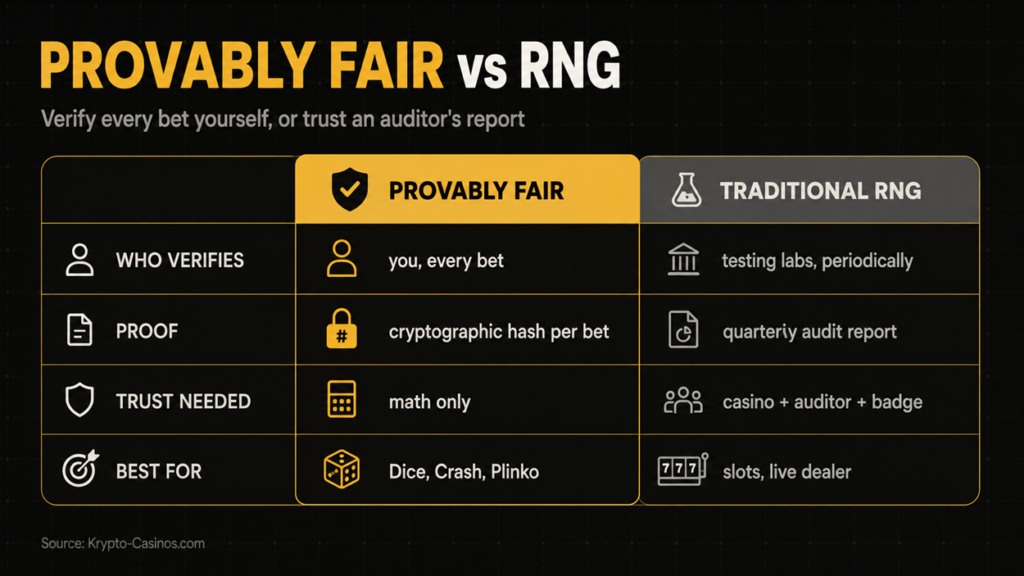
Both systems produce random results. The table below shows where each approach is stronger and where it requires compromise.
| Feature | Provably Fair | Traditional RNG |
|---|---|---|
| Verification | Cryptographic proof per bet | Third party audits (monthly/quarterly) |
| Who Checks | You (the player) | Testing laboratories |
| Speed | Instant, every round | Periodic reports |
| Transparency | Full (algorithm is public) | Limited (proprietary code) |
| Player Input | Yes (client seed) | None |
| Trust Required | Mathematics only | Casino + auditor + badge |
| Game Complexity | Simple outcomes only | Any complexity |
| Best For | Dice, Crash, Plinko, Mines | Slots, live dealer, table games |
Neither system wins across the board. Provably Fair gives you verification power but limits game complexity. Traditional RNG handles any game type but requires trusting intermediaries.
Which Games Use Which System
The verification method depends on the game. Complex games with multiple random variables use traditional RNG. Simple games with single outcomes use Provably Fair.
Traditional RNG Games
Slots involve hundreds of symbol positions, weighted reels, and bonus triggers that require the complete game code to verify. Live dealer uses physical cards on camera with no algorithm to check.
Table games like blackjack with multi hand variations create verification overhead no player would realistically complete. Progressive jackpots pool contributions across multiple casinos, which Provably Fair cannot span.
These games depend on certification from eCOGRA, iTech Labs, or GLI. You trust the auditor verified the RNG produces outcomes matching the published RTP.
The advertised house edge should match the code. Auditors check this, but you cannot.
Provably Fair Games
Rules, house edge, and ranked casino lists for each game are in our Original Games hub.
Most Crypto Casinos Run Both
House games use Provably Fair for transparency. Slots from Pragmatic Play or Hacksaw use traditional RNG because the providers control the game code. Players move freely between both sections based on what they want from each session.

Which System Should You Choose?
Neither system guarantees you win more. Both can be fair. The question is whether you want to verify fairness yourself or trust someone else to do it.
Security Comparison
Provably Fair security: Manipulation is mathematically impossible after seed commitment. You detect tampering instantly through hash mismatch. No delay between placing a bet and verifying it.
Traditional RNG security: Depends on auditor competence and independence. A casino could theoretically modify code between audits. You never see the implementation or test results.
For maximum control, play Provably Fair games. For variety and complex mechanics, stick with traditional RNG at reputable licensed casinos. Our rating methodology evaluates both systems when scoring platforms.
Does Verification Affect Your Odds?
No. The verification system does not set RTP or house edge. Verification only proves the published edge is accurate.
Provably Fair games tend to run 1% to 2% house edge. Traditional RNG slots sit at 4% to 10%. The gap comes from operational costs, not the verification method.
Specific picks across both systems are ranked in our highest RTP games list.
Actual returns also depend on bonus terms. High RTP means nothing if wagering requirements make withdrawing impossible. Provably Fair games often exclude from bonus wagering or contribute at reduced rates, while slots usually contribute 100%.
The Bottom Line
Provably Fair does not make you win more, but it makes fraud impossible to hide. You trade game variety for verification certainty. Traditional RNG gives you more options but asks you to trust the chain of auditor, casino, and badge.
Choose based on whether you prioritize checking results yourself or accessing the full range of game types and volatility settings.
Frequently Asked Questions
No. RTP comes from game rules and house edge, not verification method. Provably Fair proves the published RTP is accurate. It does not determine what that percentage is.
Theoretically yes, but practically no at licensed casinos. Modifying certified code risks license revocation and business destruction. The house edge already guarantees profit without cheating.
Complex games require too much computation to verify. A slot with cascading mechanics, weighted reels, and bonus triggers would need players to download and simulate the entire game code. Provably Fair only works for simple, single outcome games.
No. Most players verify a few bets when they start at a new casino, then spot check occasionally. If you can verify any bet at any time, the casino cannot cheat on any bet. Checking 5 random bets from a 1000 bet session is enough.
Yes. A casino could show fake seed data or broken algorithms. Always verify using independent third party tools, not the casino’s built in verifier. Copy your seeds and paste them into an external checker to confirm the hash matches.
Pick Your Verification Standard
Every casino we review is tested for both Provably Fair implementation and RNG certification. We score each platform on verification transparency, published house edges, and actual payout accuracy. See how each platform handles fairness in our ranked list.
Marcus Velder is a blockchain analyst and provably fair specialist covering the crypto gambling space since 2021. With a background in smart contract auditing and a Master's degree in Computer Science from TU Delft, Marcus brings a technical lens to every casino and game he reviews. He has personally verified hundreds of provably fair bet outcomes and dissected the cryptographic mechanisms behind every major original game format. Based in Lisbon, Portugal.