

What is RNG? How Randomness Works in Crypto Casinos
How the algorithm behind every spin, roll, and crash keeps the game fair.

The Quick Answer: RNG (Random Number Generator) is a mathematical algorithm that ensures every spin, deal, or dice roll is 100% independent and unpredictable. In crypto casinos, RNG acts as the invisible dealer, guaranteeing the house cannot manipulate results after you place your bet.
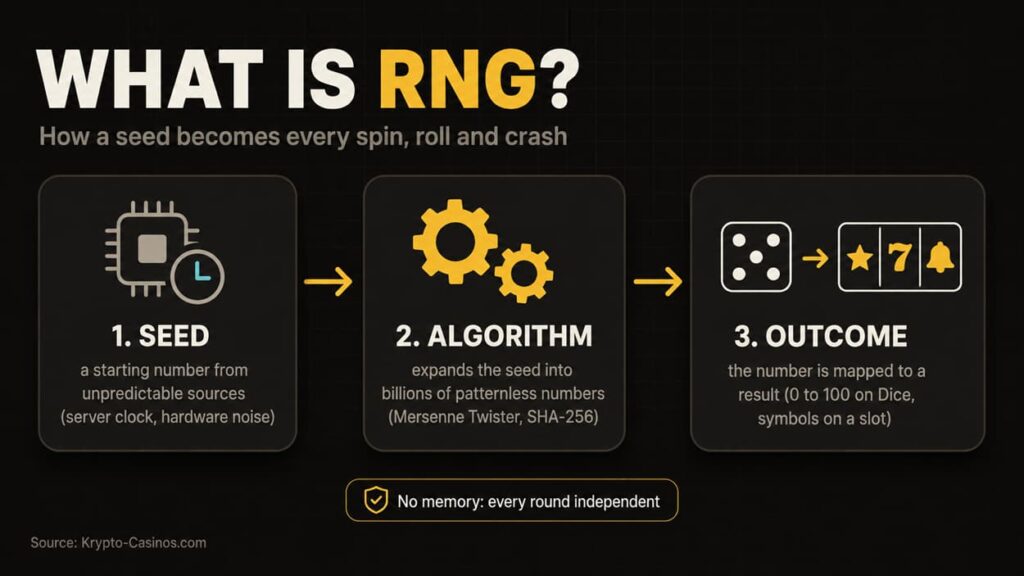
RNG is the engine behind every crypto original game. Whether you play Crash, Dice, Plinko, or Bitcoin slots, this technology guarantees your odds are set by mathematics, not by the casino. Every result is generated and locked in before you see it.
RNG enforces the house edge built into the game rules and ensures the published payout percentages play out fairly across millions of rounds.
Our casino rating methodology prioritizes platforms with audited RNG systems and transparent game mathematics. RNG verification is the first thing we check.
How RNG Works: The Invisible Shuffle
In a physical casino, a dealer shuffles once and deals. In a crypto casino, the RNG shuffles thousands of times per second in the background. The moment you click Spin or Bet, the algorithm picks the result from that exact microsecond.
1. The Seed Value
Every RNG starts with a seed: a starting number generated from unpredictable sources like the server clock (measured in nanoseconds), CPU hardware noise, or atmospheric data. This seed determines the entire sequence of random numbers that follows.
In provably fair games, you can see the hashed version of this seed before you bet. This proves the casino committed to an outcome before you made your decision.
2. The Mathematical Algorithm
The algorithm takes the seed and runs calculations that produce billions of numbers with no detectable pattern. Common algorithms include Mersenne Twister (used in most slots) and SHA-256 (used in blockchain and provably fair systems).
These algorithms pass rigorous statistical tests that verify the output is indistinguishable from true randomness. No human can predict the next number in the sequence even if they know the algorithm.
3. The Game Outcome Mapping
The raw random number is then mapped to a game result. A slot machine might map numbers 0 to 999 to different symbol combinations. A dice game maps the number to a result between 0 and 100.
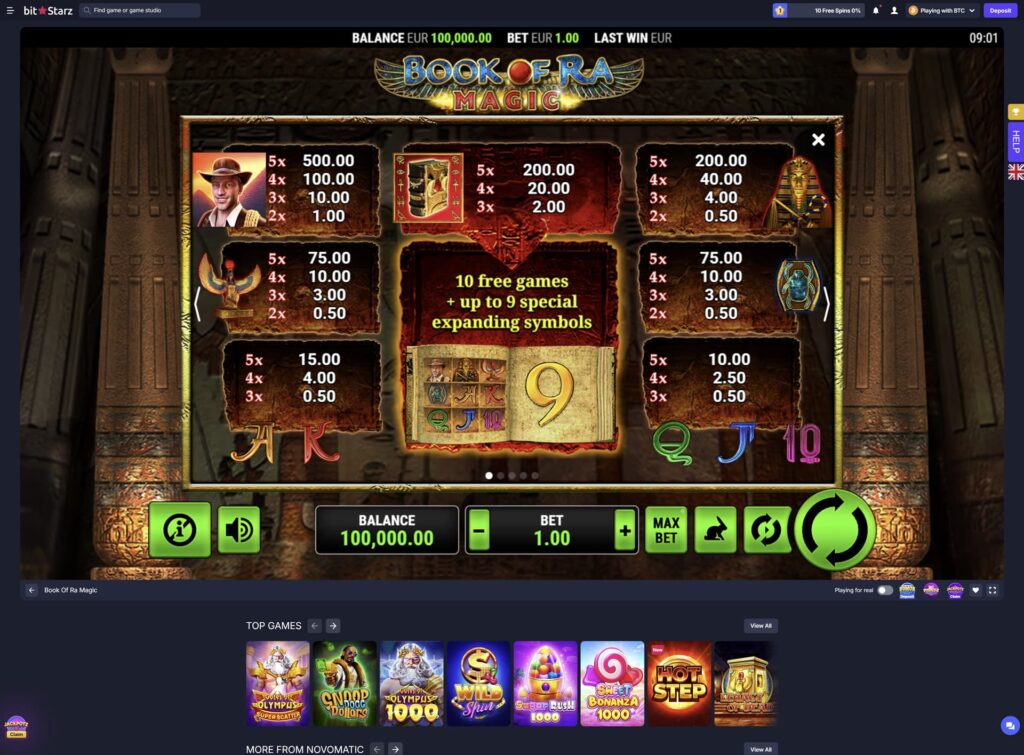
The mapping is transparent and follows the game’s published RTP and probability tables. This is where house edge is implemented.
A dice game with 1% house edge maps 0 to 495 as a win and 496 to 1000 as a loss. The RNG is perfectly random. The mapping creates the casino’s advantage.
The No Memory Rule
The RNG has no memory of previous results. Every round uses a fresh seed and generates a completely independent outcome. Hot and cold streaks are illusions created by variance, not patterns in the RNG.
PRNG vs TRNG: The Two Types of Randomness
Online casinos use two distinct technologies to generate random outcomes. The difference is academic for most players, but knowing which one your game uses helps you evaluate its verification options.
PRNG (Pseudo Random Number Generator)
PRNG is software based, extremely fast, and powers 99% of online casino games.
PRNG uses mathematical formulas to expand a seed into billions of numbers. While technically pseudo random because it follows a deterministic algorithm, the math is so complex that the output is statistically indistinguishable from true randomness.
PRNG is the gold standard for high speed games like slots, Crash, and Limbo where thousands of results must be generated per second across multiple players.
TRNG (True Random Number Generator)
TRNG is hardware based, slower, and primarily used in lottery systems and government applications.
TRNG harvests randomness from physical phenomena like atmospheric noise, radioactive decay, or thermal fluctuations in electronic circuits. Because these events are governed by quantum mechanics rather than mathematical formulas, the results are considered truly random with no possible prediction.
However, TRNG is too slow for real time multiplayer casino games and is rarely used in crypto gambling.
Why Crypto Casinos Use PRNG
For high speed crypto games, performance is everything. When 500 players are betting on the same Crash round or a slot machine is processing 100 spins per second, the RNG must deliver instant results without lag. PRNG provides perfect statistical fairness with the computational efficiency needed for real time multiplayer gaming.
The practical difference between PRNG and TRNG is irrelevant for casino fairness. Where each verification system fits and why most crypto casinos use both is covered in our Provably Fair vs RNG comparison.
Can RNG Be Rigged? Debunking the Myths
Because RNG operates behind a digital curtain, conspiracy theories spread easily. Here are the three most common ones and why they are mathematically impossible.
Myth #1: “The game is due for a win”
This is the Gambler’s Fallacy. Because every RNG round is independent, the odds of hitting a jackpot are exactly the same whether the game just paid out 5 seconds ago or has not paid out in months. The RNG does not track previous results.
A slot machine does not become “hot” or “cold.” Every spin starts from zero. If the jackpot probability is 1 in 10,000, then every single spin has exactly a 1 in 10,000 chance regardless of history.
Myth #2: “Casinos change the RNG when you win big”
Licensed crypto casinos use RNG systems locked into the game code and audited by third party labs. Manual interference would require rewriting the software, which would fail the next audit and cost the casino its license.
The house edge already guarantees long term profit. Rigging games would be both illegal and unnecessary.
Myth #3: “The RNG slows down when I’m winning”
RNG speed is set by server hardware, not player balance. Every round processes at the same speed whether you are up 10 Bitcoin or down to your last dollar. What players perceive as slowdowns is confirmation bias: losses feel sharper when you are winning.
Why Rigging RNG Would Backfire
Even if a casino wanted to rig their RNG, the consequences would destroy their business. Third party audits would detect statistical anomalies, players would notice patterns in provably fair games, and regulatory bodies would revoke licenses.
A casino operating a fair 1% house edge game earns $1,000,000 for every $100,000,000 wagered. The math alone makes cheating pointless.
What players often mistake for “rigged” games is actually volatility at work. High volatility games produce long losing streaks followed by massive wins. The math is working exactly as designed.
How to Spot an Actually Unfair Casino
Rigged RNG is rare at licensed platforms. The real red flags are simpler: no license in the footer, no provably fair verification on original games, withdrawal delays that stretch past 48 hours, and support that goes silent when you ask about payout policies.
How Do We Know the RNG is Fair?
Transparency is the industry standard. Reputable crypto casinos prove their randomness through two primary methods: third party laboratory testing and blockchain based provably fair technology. Both systems provide mathematical proof that games operate as advertised.
1. Third Party Lab Testing
Independent labs like iTech Labs, GLI, eCOGRA, and BMM Testlabs run millions of simulated rounds on casino software. They verify the statistical distribution matches the game’s advertised RTP and that no exploitable patterns exist in the output.
Casinos must pass these audits to obtain and maintain gambling licenses. Failed audits result in license revocation and public disclosure.
2. Provably Fair Verification
With provably fair games, you are the auditor. Every single round.
Provably fair games show you the hashed server seed before you bet, proving the casino committed to an outcome before you made your decision. After the round, you can verify the unhashed seed matches the original hash and recalculate the result yourself. This eliminates the need to trust third party auditors because you become the auditor.
Most crypto native games like Crash, Dice, Plinko, and Limbo implement this technology as standard. Step by step instructions for checking any bet yourself are in our verification guide.
Why Both Systems Matter
Third party audits verify the RNG implementation is mathematically sound and cannot be manipulated. Provably fair technology lets you verify individual results in real time without trusting anyone. Together, these systems provide the highest level of transparency available in gambling.
The best crypto casinos offer both: lab certification for slots and provably fair verification for originals. Which platforms combine both systems is covered in our highest RTP games list.

Frequently Asked Questions
A seed is the starting value that initializes the RNG algorithm. In provably fair games, the server generates a seed and shows you its cryptographic hash before you bet. You can also provide your own client seed to add additional randomness.
After the round, you can verify the revealed server seed matches the original hash, proving the casino could not have changed the outcome after seeing your bet.
No. RNG is the engine that generates random outcomes. RTP is the expected long term payout percentage. Think of RNG as the shuffling mechanism and RTP as the odds built into the game rules.
A slot with 96% RTP uses RNG to ensure fairness, but the game is programmed to pay back 96% of all wagers over millions of spins. The RNG ensures those payouts happen randomly rather than in predictable patterns.
No. Licensed casinos use the same audited RNG for all players. Implementing player specific RNG systems would require separate codebases that would fail third party audits.
Additionally, provably fair systems let any player verify their results use the same algorithm as everyone else. Different outcomes between players are due to random variance, not different RNG implementations.
Because the house edge guarantees the casino wins over time. Fair RNG does not mean you will win. It means your results match the mathematical probabilities built into the game.
If you play a game with 1% house edge, you will lose 1% of everything you wager on average over thousands of rounds. Short term variance can produce winning or losing streaks, but the house edge ensures the casino profits long term. Fair randomness and player profit are not the same thing.
Find Casinos with Verified RNG
Every casino we review is tested for audited RNG implementation and provably fair verification on original games. Browse our ranked casino list to compare by fairness standards, withdrawal speed, and game selection.
Marcus Velder is a blockchain analyst and provably fair specialist covering the crypto gambling space since 2021. With a background in smart contract auditing and a Master's degree in Computer Science from TU Delft, Marcus brings a technical lens to every casino and game he reviews. He has personally verified hundreds of provably fair bet outcomes and dissected the cryptographic mechanisms behind every major original game format. Based in Lisbon, Portugal.