

Provably Fair Explained: How Crypto Casino Fairness Actually Works
Why you never have to trust a crypto casino's word when you can verify the math yourself.

The Quick Answer: Provably Fair uses cryptographic hashing to let you verify every game outcome yourself. The casino commits to a result before you bet, you contribute your own randomness, and after the round you can check the math to confirm nothing was changed.
Traditional online casinos ask you to trust their word. Crypto casinos give you cryptographic proof. When you play Dice, Crash, or Plinko at a crypto casino, you can verify the fairness of every bet using publicly available algorithms and seed data.
Our casino rating methodology prioritizes platforms with provably fair implementations and transparent game mathematics. Provably fair verification is one of the first things we check.
The Problem Provably Fair Solves
At a traditional online casino, every spin and card deal is generated by a Random Number Generator running on the casino’s private servers. The algorithm is proprietary. You see the result on screen and trust it came from a fair process.
Third party labs like eCOGRA audit these systems monthly or quarterly, but you cannot verify your specific bet. That blackjack hand where the dealer pulled 21 three times in a row? No audit trail, no cryptographic proof, no way to confirm the odds were not adjusted.
Provably fair replaces this trust with mathematics. The casino commits to every outcome before you bet, and you verify the math afterward. No reputation required, no auditor required, just verifiable proof.
How Provably Fair Works
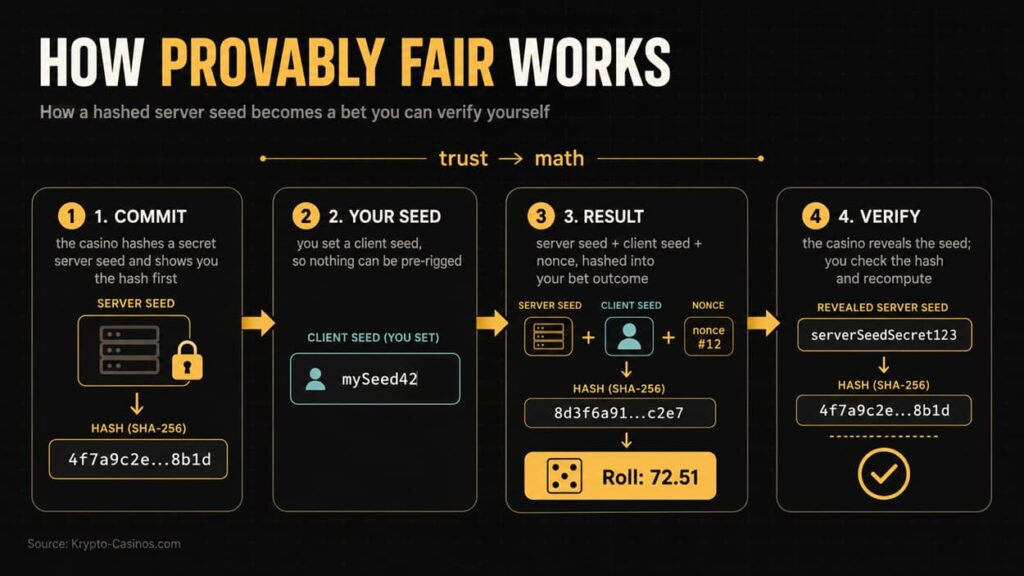
Every provably fair bet uses three pieces of data to generate the outcome. Change any one of them and the entire result changes.
| Component | Who Controls It | Purpose |
|---|---|---|
| Server Seed | Casino generates | Casino’s randomness. Hashed before your bet so they cannot change it. |
| Client Seed | You generate or influence | Your randomness. Prevents the casino from predetermining outcomes. |
| Nonce | Increments automatically | Counter (0, 1, 2, 3…) ensuring each bet with same seeds produces different results. |
The Two Phase Process
Before your bet: The casino generates a server seed and shows you its SHA-256 hash, which acts as a sealed envelope. You provide your own client seed (or accept a random default) and both seeds lock before the round starts.
After your bet: The casino reveals the unhashed server seed. You hash it yourself and confirm it matches the pre bet commitment, then run the full algorithm to verify the output matches what you saw on screen.

If the casino changed the server seed after seeing your bet, the hash would not match. You catch manipulation instantly. This is why SHA-256 hashing makes provably fair work: changing even one character in the seed produces a completely different hash.
Dice Bet Example
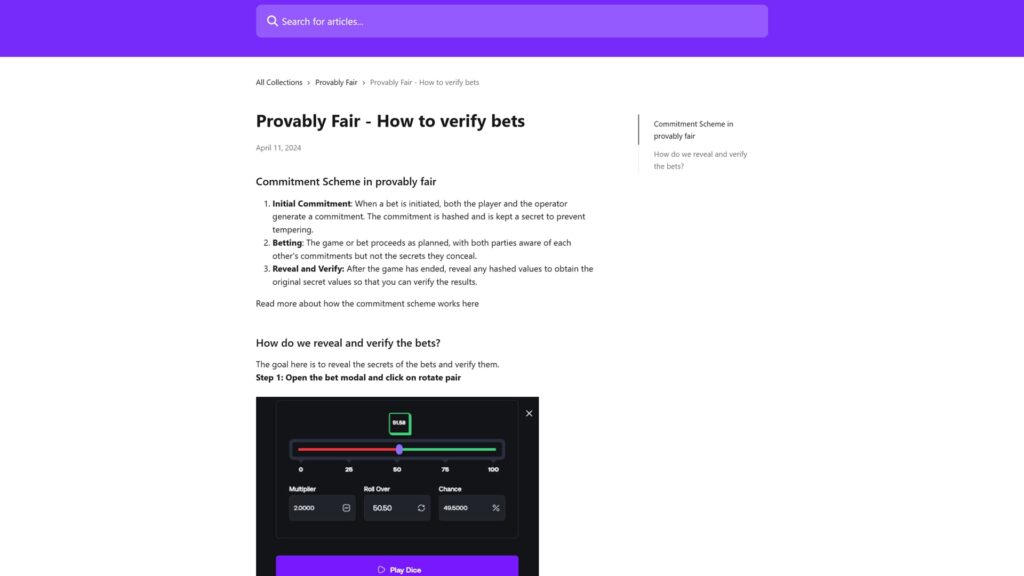
You set your target to roll under 50.50. The casino shows you the hashed server seed. You set your client seed to “MyCustomSeed123” and bet.
The algorithm combines both seeds with nonce 0 and produces 42.18 (you win). After the round, the casino reveals the unhashed seed. You hash it yourself, confirm it matches, run the algorithm, and it outputs 42.18.
Which Games Use Provably Fair
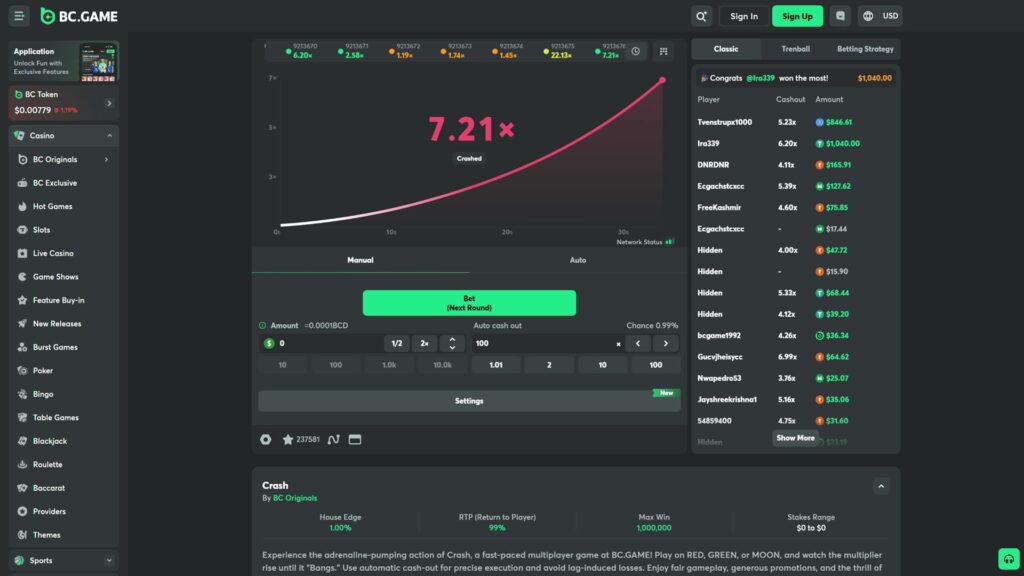
Provably fair works for games with simple, verifiable outcomes. Complex games like slots use traditional RNG instead. Where each system fits and why most crypto casinos run both is covered in our Provably Fair vs RNG comparison.
Third party slots from providers like Pragmatic Play and Hacksaw use traditional RNG audited by eCOGRA, iTech Labs, or GLI. These games are not provably fair. You trust the auditor, not the math.
How to Verify a Bet
Verification takes under 30 seconds once you know where to find your seed data. You do not need programming skills or deep cryptography knowledge.
Step 1: Open your bet history and find the bet you want to verify. Copy the server seed (revealed after the round), your client seed, and the nonce.
Step 2: Paste all three values into an independent third party verification tool (not the casino’s built in verifier).
Step 3: Compare the output to what you saw on screen. If the numbers match, the bet was fair. If they do not match, the casino faked the implementation.
The step by step process for each game, third party tool comparisons, and what to do if verification fails are all in our verification guide.
What Provably Fair Does NOT Guarantee
Provably fair proves the game is not rigged. It does not prove the casino is safe to use. A casino can have perfectly fair games and still refuse to process your withdrawal.
What it covers: Game outcome fairness, randomness verification, house edge accuracy, and seed integrity. Each bet is verifiable and cannot be manipulated after commitment.
What it does not cover: Casino solvency, withdrawal reliability, regulatory compliance, or business longevity. Fair math does not prevent exit scams.
High volatility settings can drain your bankroll quickly even on provably fair games. Fairness means the math is honest, not that you will win.
Always verify the casino’s licensing, withdrawal track record, and reputation separately. Every verification step beyond game fairness is in our beginner’s checklist.
Spotting Fake Provably Fair Implementations
Not every casino claiming provably fair implements it correctly. Some use the label as marketing while running broken or deliberately misleading systems.
Frequently Asked Questions
Only if the implementation is fake. A properly built system with SHA-256 hashing makes manipulation mathematically impossible because the casino commits to outcomes before you bet. Always verify using independent tools, not the casino’s built in checker.
No. Changing your client seed changes which outcomes you receive, but not the house edge or your long term expected value. Every seed combination produces the same statistical distribution over millions of bets.
No. Most crypto casinos only offer provably fair on original house games like Dice, Crash, and Plinko. Third party slots and live dealer tables use traditional RNG audited by testing labs.
No. It proves the house edge is implemented correctly. A provably fair Dice game with 1% house edge still has a 1% edge. The difference is you can verify that 1% is actually 1% rather than secretly 3% or 5%.
No. Most players verify a few bets when they start at a new casino, then spot check occasionally. The point is that verification is possible at any time. If you can check any bet, the casino cannot cheat on any bet.
Find Casinos with Verified Provably Fair
Every casino we review is tested for provably fair implementation on original games, RNG certification on third party slots, and actual withdrawal reliability. Compare platforms by fairness standards and payout speed in our ranked list.
Marcus Velder is a blockchain analyst and provably fair specialist covering the crypto gambling space since 2021. With a background in smart contract auditing and a Master's degree in Computer Science from TU Delft, Marcus brings a technical lens to every casino and game he reviews. He has personally verified hundreds of provably fair bet outcomes and dissected the cryptographic mechanisms behind every major original game format. Based in Lisbon, Portugal.