

How to Verify Provably Fair Bets: Step by Step Guide
A casino can implement Provably Fair correctly or fake it entirely. You cannot tell the difference unless you verify it yourself.

The Quick Answer: Copy three values from your bet history (server seed, client seed, and nonce), paste them into a third party verification tool, and confirm the calculated result matches what you saw on screen. The process takes 3 to 5 minutes with no coding knowledge required. If the numbers match, the casino played fair, and if they do not, you have mathematical proof of manipulation.
Most people playing crypto casino games never verify their bets. They see the “Provably Fair” badge and assume it means automatic fairness, so they keep playing. Provably Fair technology gives you the power to verify things, but only if you actually use it.
A casino can either properly implement Provably Fair or pretend to. At first glance, the two can look identical unless you verify the system yourself. A real Provably Fair setup shows you the hashed server seed before you place a bet and reveals the unhashed version afterward, allowing you to check that nothing has been changed.
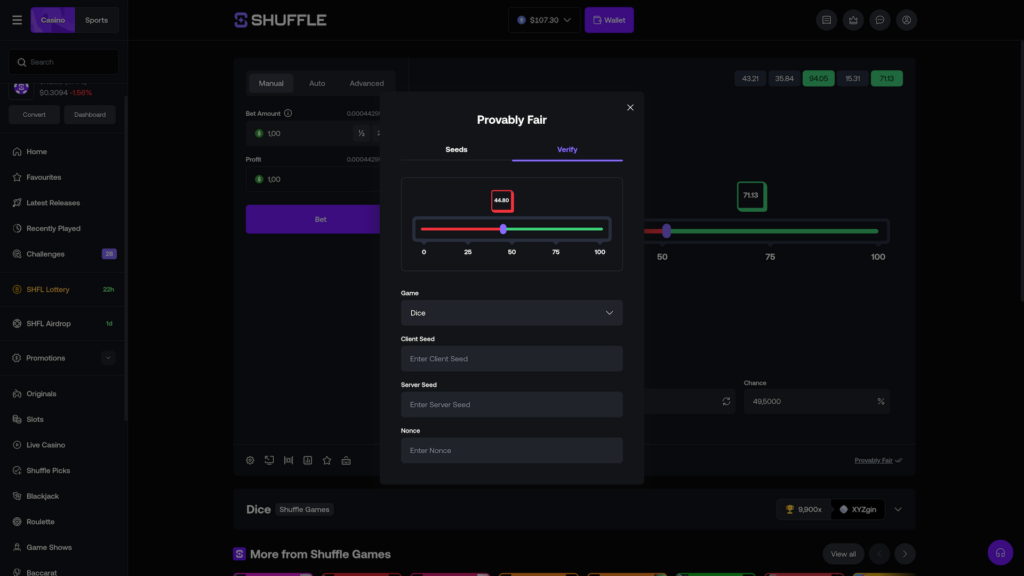
3 Step Universal Verification Process
The core verification process is the same for all Provably Fair games, whether you’re playing Dice, Crash, or Plinko. While the exact formula may differ from game to game, the underlying cryptographic method remains consistent. Once you understand these three steps, you can verify that any crypto casino is fair.
Step 1: Get Your Seeds from Bet History
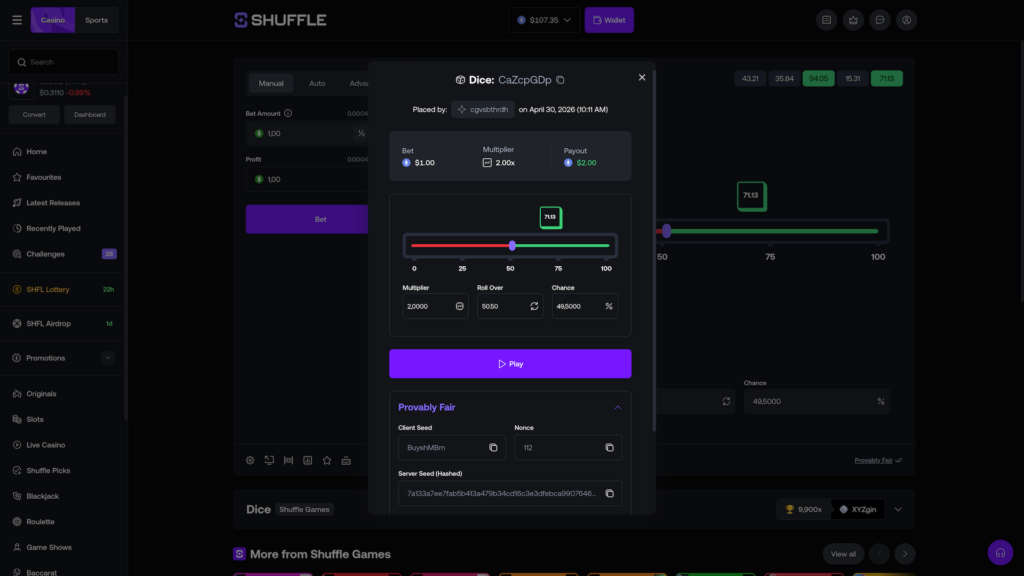
Open your bet history and find the bet you want to check. Copy three pieces of data from the “Verify” or “Fairness” section of the bet details.
Step 2: Hash the Server Seed and Verify It Matches
Before you place your bet, the casino shows you a hashed version of the server seed. This hash is a cryptographic commitment: once the bet is complete and the casino reveals the unhashed server seed, you verify that hashing the revealed seed produces the same hash you saw before betting.
Apply SHA-256 to the revealed server seed and compare the output to the hash you saw before betting. If they match exactly, the seed was not changed. If they differ by even one character, the casino altered the server seed after seeing your bet.
Step 3: Run the Game Formula and Compare Results
Each game uses a different formula to combine the server seed, client seed, and nonce to generate a random result. To verify the outcome, enter these three values into a tool that supports the specific formula of the game in question.
The tool will then calculate the result that those seeds should have produced. Then, compare the output with the actual result when the bet was placed. If they match exactly, the game outcome was fair.
Pro Tip: Always use a third party tool to verify, not the casino’s built in verifier. A rogue casino can build a fake verification interface, but it cannot fake the independent cryptographic calculations performed by external tools.
What Each Component Does
| Component | Source | Purpose |
|---|---|---|
| Server Seed | Casino generates | Casino’s contribution to randomness. Committed via hash before your bet to prevent manipulation. |
| Client Seed | You provide or customize | Your contribution to randomness. Prevents casino from predetermining outcomes. |
| Nonce | Auto increments with each bet | Counter ensuring each bet with the same seeds produces a different result. |
| Server Seed Hash | Casino shows before bet | Cryptographic commitment. Proves casino cannot change server seed after you bet. |
Neither party can cheat. The casino commits its server seed before knowing your bet, and you contribute randomness through your client seed. The combination creates outcomes that cannot be predicted but can be confirmed mathematically after the fact.
Game Specific Verification Guides
Every game that’s designed to be fair uses a unique formula to turn seeds into outcomes. The verification process is the same, but you need to know which formula applies to which game.
How to Verify Dice Bets
Dice is the simplest provably fair game to verify. The seeds produce a single random number between 0 and 99.99. You win if that number falls within your chosen range.
Dice Verification Formula
1. Combine server seed + client seed + nonce into a single string.
2. Generate HMAC SHA256 hash of this combined string.
3. Take the first eight characters of the hash, convert them from hexadecimal to decimal, and then divide by 429496.7296. This will give you a result between 0 and 99.99.
For example: If your hash starts with “a3f5b2c1”, the tool converts it to a roll result of 64.05. If you bet “Under 65,” you won. The exact conversion formula varies slightly between casinos, which is why third party tools handle the math for you.
Most third party verifiers handle this automatically. Paste your seeds, select “Dice” as the game type, and the tool calculates whether the result matches. Full game mechanics and strategy are in our Dice guide.
How to Verify Crash Bets
Crash uses a hash chain instead of individual seed pairs. The casino pre-generates 10 million crash points in sequence and publishes the final hash. Each round reveals one point from the chain, working backward.
Crash Hash Chain Verification
1. Casino publishes the final hash in the chain (hash #10,000,000).
2. Each game reveals the hash for that round. Hash the revealed value repeatedly until you reach the published final hash.
3. If your repeated hashing reaches the final hash, the chain is valid. Use the game formula to convert the revealed hash to a crash multiplier.
For example: The hash code “3a5f7c9…” translates to crash point 2.45x. If the game shows 2.45x on the screen, the verification passes.
The hash chain system makes it impossible to manipulate Crash because the casino commits to millions of future crash points before the first game starts.
How to Verify Plinko Bets
Plinko has multiple random outcomes per bet because the ball bounces left or right at each peg level. An 8 row board requires eight random decisions, while a 16 row board requires 16. Verification confirms each bounce direction was predetermined by the seeds.
Plinko Path Verification
1. Generate HMAC SHA256 hash from server seed + client seed + nonce.
2. For each row, take the next byte from the hash. If byte value is 0 to 127 the ball goes left, and if 128 to 255 it goes right.
3. Track the path through all rows to determine final landing bucket. Verify the landing bucket matches your on screen result and payout.
Example: On a 12 row board, bytes generate path “RLRLLRRLRLRL” landing in bucket 5. If payout matches bucket 5 multiplier, verification passes.
Verifying Plinko is more complex than Dice because you check the entire bounce path instead of a single number. Third party tools handle the byte to direction conversion automatically.
How to Verify Mines Bets
Mines generates the full board layout before you make your first click. The verification process confirms that mine positions were locked in using your seeds and were not changed based on which tiles you selected.
Mines Board Generation
1. Use the server seed, the client seed, and the nonce to generate a hash.
2. Use the hash to shuffle the 25 tile positions into a random order. The first N positions in the shuffled array become mine locations.
3. All remaining positions are safe tiles. Compare the generated mine positions against the board layout you saw during gameplay.
Example: There are three mines on a 5×5 board. Hash shuffles tiles and places mines at positions 7, 14, and 22. If you hit tile 7 and see a mine, that means it was predetermined.
The critical step in Mines verification is confirming the board was generated entirely before your first click. If the verification shows different mine positions than you encountered, the casino manipulated the outcome.
How to Verify Limbo Bets
Limbo verification works almost the same as Dice, but it uses a different multiplier formula. Instead of generating a number between 0 and 100, Limbo creates a multiplier that can reach infinity.
Limbo Multiplier Formula
1. Generate HMAC SHA256 hash from server seed + client seed + nonce.
2. Take the first eight characters, convert them from hexadecimal to decimal, and divide by 429496.7296. This will give you a number between 0 and 99.99.
3. Use the Limbo formula: Multiplier = 99 / (100 minus the result). Round to two decimal places.
Example: The result is 95.5. Formula: The multiplier is 22.00x. This is because 99 divided by 100 minus 95.5 equals 22.00x. If the game shows 22.00x, the verification passes.
The Limbo formula creates a distribution where most results fall below 2x, but rare outcomes reach 100x or higher. Understanding volatility helps you manage bankroll expectations at high target multipliers.
Recommended Verification Tools
Don’t just trust the casino’s built-in verification tool. A fraudulent casino can show fake seed data or run faulty algorithms through their own verifier. Always check the results with tools from outside the company.
Search for “provably fair verifier” followed by the game name (Dice, Crash, Plinko). Look for open source tools where the community has reviewed the code. Many casinos also link to independent verifiers in their fairness documentation.
How to Use a Third Party Verifier
Copy your server seed, client seed, and nonce from the casino’s bet history. Open the verification tool in a new browser tab, select the game type, paste each value into the corresponding field, and click “Verify.” Compare the calculated result to your actual bet outcome.
Critical Security Rule: For high-value bets, use at least two different verification tools. If the two tools show the same calculated result and it matches what you see on your screen, you can be sure that the bet was fair.
Many casinos link to third party verifiers in their fairness documentation. These links can be convenient starting points, but always confirm results with a completely independent tool. How accessible each platform makes its verification data is part of our rating methodology.
Red Flags That Indicate Fake Provably Fair
Not every casino that claims Provably Fair actually implements it correctly. Some display verification buttons while running fake systems behind the scenes.
If Verification Fails: Most mismatches are user error, not manipulation. Check these before assuming fraud.
1. Re-copy all seeds directly from the casino interface. An extra space or missing character changes the result.
2. Try a different verification tool. Some tools use outdated algorithms or incorrect seed formatting.
3. Confirm the nonce matches the specific bet you are checking, not the current nonce.
4. Contact support with the bet ID, all seed values, your calculated result, and the displayed result.
5. If multiple tools confirm a mismatch and the casino will not investigate, file a complaint with the licensing authority.
Consistent mismatches across multiple bets and tools indicate either a broken system or deliberate fraud. Stop playing and withdraw your funds immediately. Our Provably Fair vs RNG comparison explains how cryptographic verification differs from traditional third party auditing.
Frequently Asked Questions
Three to five minutes once you know where to find your seed data. The first verification takes longer because you need to locate the bet history section and identify which fields contain which seeds. After two or three checks, the process becomes routine.
No, tools made by other companies handle all the cryptographic calculations automatically. All you have to do is copy the server seed, client seed, and nonce from your betting history and paste them into the verification tool.
Yes. Most verification tools work perfectly on mobile browsers. The process is the same as on a desktop computer: access your bet history, copy the seeds, open a verification tool in a new tab, paste the values, and compare the results.
Reputable open source verifiers are safe because the community audits the code against official provably fair specifications. Never use a tool that asks for your casino login or private keys. Verification only requires your seeds and nonce, which are public bet history data.
A shady casino might create a verification interface that shows fake seed data or uses faulty algorithms that always say “verified.” You should always check with independent third-party tools that aren’t connected to the casino.
If a casino claims provably fair but hides seed data or blocks access to complete bet history, the implementation is fake. Withdraw your funds and find a platform that provides full seed transparency.
Verify Before You Trust
Start with any bet from your history and verify it using two independent tools. Once the process is familiar, spot check a few bets per session to confirm the casino is operating honestly.
Understanding the house edge alongside game fairness helps you calculate expected value at any crypto casino. Our RTP guide covers how return percentages affect your long term results. Find platforms with verified provably fair in our ranked list.
Marcus Velder is a blockchain analyst and provably fair specialist covering the crypto gambling space since 2021. With a background in smart contract auditing and a Master's degree in Computer Science from TU Delft, Marcus brings a technical lens to every casino and game he reviews. He has personally verified hundreds of provably fair bet outcomes and dissected the cryptographic mechanisms behind every major original game format. Based in Lisbon, Portugal.