

How Plinko Works: Row Count, Risk Levels, and the Math Behind Every Drop
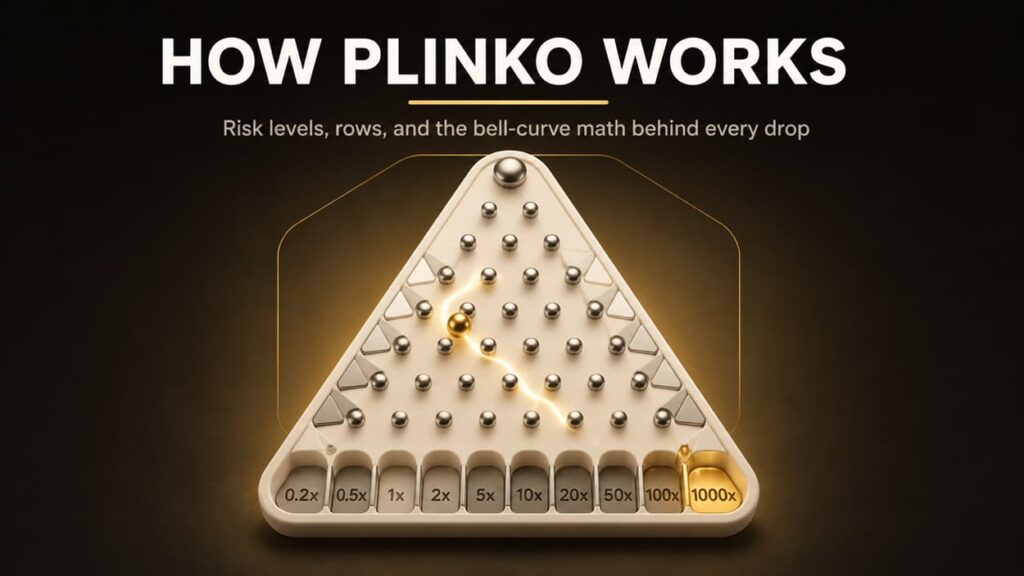
One ball, sixteen rows of pegs, and a 1,000x multiplier waiting on the edge. You control the risk level, the row count, and when to walk away.

The Quick Answer: Plinko is a ball drop game where each peg is a 50/50 bounce. You choose 8 to 16 rows and a risk level (Low, Medium, High) to control how the game pays you. Most crypto Plinko games operate at 99% RTP with a 1% house edge.
The ball follows binomial distribution, which means center slots are hit thousands of times more often than edges. This is why edge multipliers reach 1,000x while center slots pay 0.2x. Understanding this distribution and how volatility settings shape it makes the difference between playing blind and playing smart.
How Plinko Works: The Two Settings You Control
Every round starts with you clicking Drop. The ball falls from the top of the pyramid, bouncing left or right at each peg with 50% probability. After hitting all pegs, it lands in a slot with a multiplier that determines your payout.
Rows (Pyramid Height)
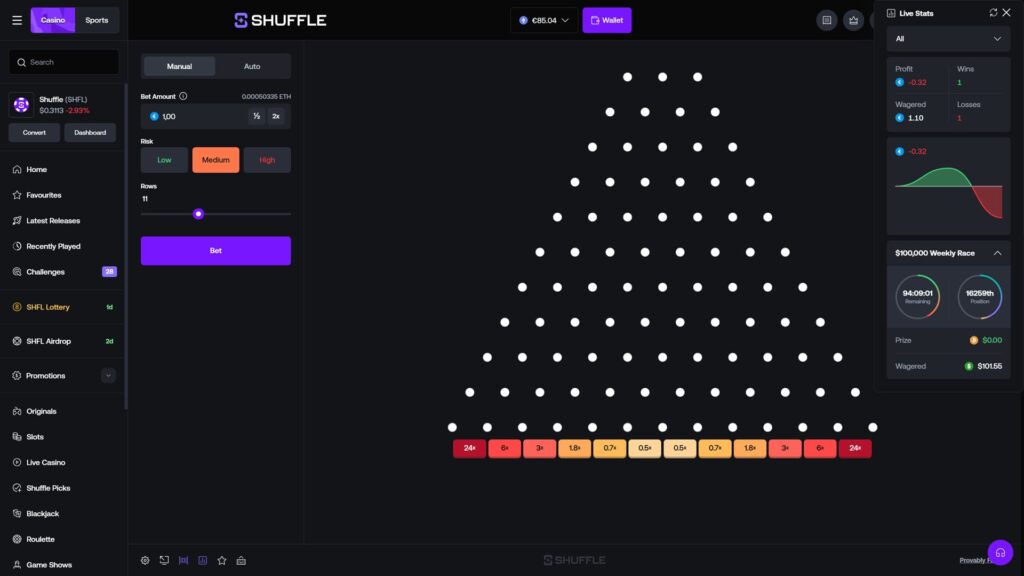
Most crypto Plinko games let you choose between 8 and 16 rows. More rows means more bounces and more possible outcomes.
Risk Level (Multiplier Distribution)
Risk level changes the multiplier values in the slots. The ball still follows the same physics, but the payouts change dramatically.
| Risk Level | Center Slots Pay | Edge Slots Pay | Character |
|---|---|---|---|
| Low | 0.7x to 1.1x | 3x to 10x | Hard to lose your stake, big wins rare |
| Medium | 0.4x to 0.7x | 10x to 50x | Balanced between safety and upside |
| High | 0.2x to 0.4x | 100x to 1,000x | Most drops lose, but edges pay 100x to 1,000x |
Why center pays less: If you flip a coin 16 times, getting 8 heads and 8 tails (center) is far more likely than 16 heads in a row (far edge). The casino prices multipliers based on this mathematical rarity, which is how they offer 1,000x on edges while maintaining 99% RTP.
The Bell Curve Math
Plinko is a visual demonstration of binomial distribution. On a 16 row pyramid, there are 65,536 possible paths the ball can take. The distribution is not even.
| Landing Zone | Paths (out of 65,536) | Probability |
|---|---|---|
| Center slot | 12,870 | 19.6% of drops |
| Within 3 slots of center | ~45,800 | ~70% of drops |
| Far edge (either side) | 2 | 0.003% of drops |
This means 70% of all drops land in the center zone regardless of your risk setting. The risk level only changes how much those center and edge slots pay. The ball does not care about your settings.
Plinko operates at a 1% house edge, which means 99% RTP. Even when players hit a 1,000x edge, the casino has already collected hundreds of 0.2x center losses.
Over millions of rounds, the distribution always converges. Plinko’s 99% RTP means the casino keeps 1% of all wagering regardless of which risk level or row count you choose.
Four Plinko Strategies
You cannot change where the ball lands, but you can change how the board pays you. Pick the strategy that matches your goal and stick with it for the entire session.
| Strategy | Settings | Best For | Bankroll Impact |
|---|---|---|---|
| Bonus Grinder | Low Risk / 16 Rows | Clearing wagering requirements | Lose 1% to 2% per 100 drops |
| Balanced Player | Medium Risk / 16 Rows | Stability with jackpot potential | Moderate swings |
| Edge Hunter | High Risk / 16 Rows | Chasing 1,000x multipliers | Violent swings, need large bankroll |
| Quick Hitter | Medium Risk / 8 Rows | Short sessions, fast action | Moderate, faster resolution |
The Bonus Grinder is the most popular because Low Risk center slots return 0.7x to 1.1x per drop, letting you churn through wagering requirements while keeping 80% or more of your bankroll intact.
Avoid switching strategies mid session. Starting on Low Risk, losing patience, switching to High Risk to recover, then panicking back to Low Risk is how players turn small losses into catastrophic losses. Commit before you start.
Provably Fair Verification
Every Plinko drop uses provably fair technology. The server seed determines the left/right direction at every single peg before the ball is released, and this seed is locked with a SHA-256 hash you can see before you click “Drop.” The entire bounce path is predetermined.
After the ball lands, you can take the revealed server seed and reconstruct the full path peg by peg to confirm it matches what you saw on screen. This makes Plinko one of the easiest provably fair games to verify visually because you can literally trace each bounce. The full process is in our verification guide.
Frequently Asked Questions
No. The server seed determines every left/right bounce at each peg before the ball is released. Even though the ball visually appears to bounce randomly, the path is fully predetermined and follows binomial distribution with no pattern between drops.
It depends on your goal: Low Risk with 16 rows for bonus clearing, Medium Risk with 16 rows for balanced play, and High Risk with 16 rows for jackpot hunting. For quick sessions, Medium Risk with 8 rows works well. There is no universally best setting.
On a 16 row board, each far edge has a 1 in 65,536 chance per drop. Since both edges pay 1,000x, the combined probability of hitting either one is roughly 1 in 32,768 drops. At 1,000 drops per day, you would expect to hit it roughly once a month.
No, the RTP stays at 99% regardless of settings. What changes is the volatility: Low Risk gives frequent small returns while High Risk gives rare massive returns. You are choosing how the game distributes the 99% return, not changing the total amount returned.
Mathematically, yes. Plinko offers 99% RTP versus 94% to 96% for most slots, and gives you control over volatility through risk settings. However, slots offer themes, bonus features, and visual variety that Plinko does not.
Start Playing Plinko
Plinko is pure physics and probability with no decisions after you click Drop. The closest alternatives are Crash for live multiplier tension and Dice for precise odds control with a slider.
For available row counts, risk level options, and provably fair verification across platforms, see our Plinko casino rankings.
Tomas Lindgren is the Education and Responsible Gambling Editor at KryptoCasinos. With a journalism degree from Stockholm University and a postgraduate certificate in Digital Media from the University of Malta, Tomas spent three years covering cryptocurrency adoption across the Nordics before relocating to Malta in 2018. He specializes in breaking down complex crypto gambling concepts into step by step guides that anyone can follow. Based in Malta.